The Complete Guide to Surfing Through Autumn When the Crowds Leave and the Swell Arrives
Quick Answer: Autumn brings larger, more consistent swell from distant storm systems, water still warm from summer, offshore morning winds, and far fewer people. The trade-offs are shorter daylight, colder air, more powerful waves, and rip currents that shift with the changing sandbanks. Upgrade your wetsuit, recheck the bathymetry at your break, and shift sessions later in the morning.
Ask any experienced surfer in a temperate region which season they’d keep if they could only have one, and most say autumn. Ask a casual surfer when they stop, and most say September. This guide is about the gap between those two answers.

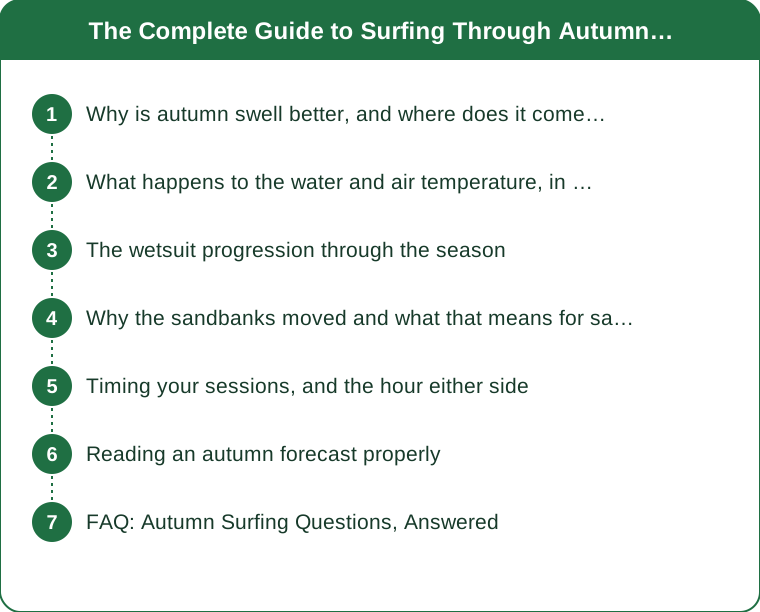
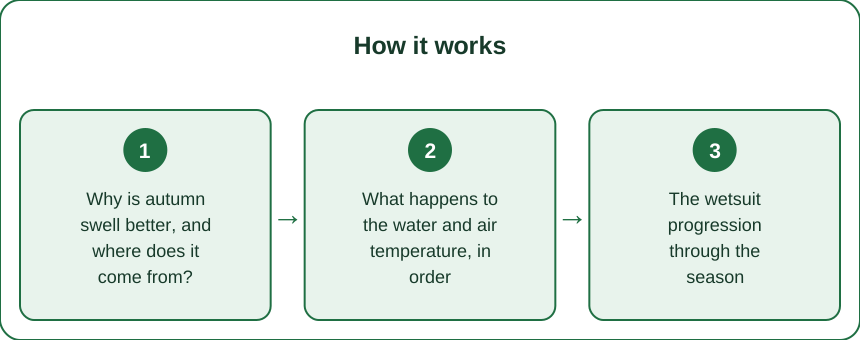
Why is autumn swell better, and where does it come from?
The mechanism is straightforward once you know it, and understanding it changes how you read a forecast.
Surf swell is generated by wind blowing over water for a sustained distance and duration. Big, organised swell comes from large storm systems well offshore, not from local wind.
In summer, temperate oceans are relatively quiet. Storm activity is low, the systems that do form are weak, and most summer surf is short-period wind swell generated close to shore. It’s disorganised, weak, and inconsistent.
From late September onward, the temperature gradient between polar and tropical air increases, which drives stronger and more frequent low-pressure systems. Those systems generate long-period groundswell that travels thousands of kilometres, organising as it goes.
Long-period swell behaves fundamentally differently when it reaches shallow water. It carries more energy, it stands up more steeply, and it breaks more powerfully and more predictably than short-period wind swell. A 1.5 metre swell at 14 seconds is a completely different, and much better, wave than 1.5 metres at 7 seconds.
This is also why autumn forecasts need reading differently. Period matters at least as much as height, and a modest-looking autumn forecast with a long period is often a far better day than a bigger-looking summer one. Learning to read period is arguably the single most valuable skill for extending your season.
What happens to the water and air temperature, in order
The sequence is what makes autumn workable, and it’s worth knowing precisely because it determines your kit for weeks at a time.
Air temperature peaks in mid to late summer and starts falling immediately. Water temperature peaks four to six weeks later, typically late August to mid September in northern temperate regions, because water’s high heat capacity makes it slow to change.
That lag creates the autumn sweet spot: several weeks where the water is at or near its annual maximum while the air has already cooled and the crowds have already gone. In many places, mid-September water is warmer than mid-June water, and mid-June is packed.
Water then cools steadily through October and November, dropping perhaps a degree a week depending on location and depth. This is gradual enough that acclimatisation happens naturally if you keep surfing, and abrupt enough that a six-week gap makes returning genuinely unpleasant.
Air temperature, meanwhile, falls faster. By late October in many temperate locations, the air is considerably colder than the water, which flips the problem. The session itself is fine; the changing, the walk to the water, and the time sitting in the car park become the limiting factors.
The practical implication is that autumn kit decisions should be driven by what happens before and after the surf as much as by what happens during it. This is where most people get it wrong, buying a warmer wetsuit when what they needed was a changing robe and a flask.
The wetsuit progression through the season
Getting this right is the difference between a season that extends into December and one that ends in October.
Early autumn, water 17 to 19 degrees. A 3/2 millimetre full suit is standard and comfortable. Many people are still in shorties on warm days. This is the easiest kit period of the year.
Mid autumn, water 14 to 17 degrees. A good 4/3 becomes the right call, and this is the single most important wetsuit purchase for a temperate surfer. Boots become worth having toward the lower end of this range, mostly for the walk over cold rocks or sand rather than for the water itself.
Late autumn, water 11 to 14 degrees. A 4/3 with a hood, or a 5/4 hooded, plus boots and usually gloves. Hood first, because a large proportion of heat loss in cold water is from the head, and a hood extends a session more than an extra millimetre on the body.
Fit matters more than thickness. A well-fitting 4/3 is warmer than a loose 5/4, because the warming mechanism relies on a thin layer of water being trapped and held still against your skin. A loose suit flushes cold water through constantly. This is worth trying on properly rather than buying online on thickness alone.
Seams matter almost as much. Flatlock seams have holes; glued and blind-stitched seams don’t. For autumn and winter, sealed seams are worth the price difference and they’re the spec most often overlooked.
And if your suit is three or four seasons old, be honest about it. Neoprene compresses over time and loses insulation. A suit that was warm two winters ago is measurably less warm now.

Why the sandbanks moved and what that means for safety
This is the autumn factor that gets least attention and matters most for safety, particularly at beach breaks.
Sandbanks are shaped by wave energy. Through a calm summer, they settle into a relatively stable configuration, and regulars learn where the peaks are, where the channels sit, and where the rips run.
The first substantial autumn swells reorganise all of it, sometimes within a single big weekend. The bank you surfed all summer may be gone, a new one may have formed 50 metres down the beach, and crucially, the rip currents will be in different places.
Rip currents are the leading cause of surf rescues, and autumn is when the mental map most surfers rely on becomes out of date without them noticing.
What to do about it: spend ten minutes watching before your first session after any significant swell event. Look for the darker, calmer-looking channels where water is flowing back out, look for where waves are and are not breaking, and watch where floating debris moves. If there are lifeguards still on duty, ask them. They will know precisely what changed.
Also worth knowing: autumn is when many beaches reduce or end lifeguard cover, often while conditions are getting more serious. Check the dates for your break. Surfing a reorganised beach break with bigger swell and no lifeguard cover is a meaningfully different proposition from the same beach in August, and it argues strongly for surfing with other people. This is general information, not a substitute for local knowledge or professional safety advice.
Timing your sessions, and the hour either side
Timing around light and wind
Autumn rewards planning in a way summer doesn’t, and two variables drive it.
Wind. Autumn mornings frequently have offshore or light winds as the land cools overnight, with onshore winds building through the day as the land warms. Offshore wind holds the wave face up and produces clean conditions; onshore wind crumbles it. That daily pattern means the surf is often best in the first few hours after sunrise and progressively worse through the afternoon.
Light. Sunrise moves later rapidly through autumn, by roughly a minute and a half a day in mid-latitudes, and sunset moves earlier at a similar rate. The window shrinks from both ends, and by late October it can be well over two hours shorter than in early September.
Those two pull in opposite directions for anyone with a job. The best conditions move into the early morning exactly as the early morning gets dark and cold.
The practical resolutions: prioritise weekend dawn sessions when the forecast is good, since the quality difference between a dawn session and a midday one in autumn is large. Accept mid-morning on weekdays, and check whether your break has an afternoon offshore pattern, since some coastlines do. And once the clocks change, be realistic that weekday surfing may be over for the season, which is an argument for making the weekends count rather than for stopping altogether.
One more timing note: tides matter more with bigger swell. A break that works across the tide in small summer surf may only work on a specific part of the tide once the swell is bigger, which further narrows the window and further rewards planning.
The before and after, which is where autumn is actually won
The session is rarely the problem. The hour either side is.
Changing. A changing robe is the highest-value autumn purchase after the wetsuit itself. Changing in a car park in wind and rain is where autumn surfing stops being fun, and a robe solves it almost entirely. A bucket to stand in for the wetsuit removal keeps sand out of the car and your feet off cold ground.
Warmth after. A flask of something hot in the car changes the whole experience. Core temperature keeps dropping for a while after you get out, an effect known as afterdrop, as cold blood from the extremities returns to the core. Getting warm from the inside, and getting dry clothes on quickly, matters more than most people realise.
Wetsuit care. Rinse in fresh water after every session and hang it on a wide hanger out of direct sun. Autumn suits get used more and dried less, and a suit that goes in the boot wet repeatedly will develop a smell that never fully leaves and will degrade faster.
A second suit, or at least a plan for a wet one. Putting on a cold wet wetsuit at 7am is genuinely one of the worst experiences in the sport. If you surf multiple days in a row, either dry it properly with the help of some airflow or accept the misery. A cheap second suit is worth considering for anyone surfing three or more times a week.
Hydration and food. Cold water surfing burns considerably more energy than summer surfing, both from the exertion and from thermoregulation. Eating properly beforehand extends how long you last, and it’s the reason people bonk on autumn sessions that would have been easy in July.
Reading an autumn forecast properly
This is the skill that separates people who score good autumn days from people who show up to blown-out ones.
Swell period is the headline number. Anything at 12 seconds or more is groundswell and worth paying attention to. Under 8 seconds is local wind swell and usually disorganised.
Swell direction versus your break’s orientation. A big swell from a direction your break is sheltered from produces nothing. Knowing your break’s optimal swell window is essential local knowledge and worth asking about.
Wind direction and strength, which usually decides the day. Offshore or light and variable is what you want. More than about 15 knots onshore and it’s likely not worth the drive.
Tide state relative to what your break needs. More critical with bigger swell.
The gap between models. When forecast models disagree substantially, that’s genuine uncertainty rather than an average, and autumn systems change faster than summer ones. Checking again the evening before is worth doing.
And a discipline that pays off: keep a simple log of conditions and how it actually was. Three months of that teaches you more about your local break than any forecast site, because it calibrates the forecast to what actually happens at your specific stretch of beach. Most surfers who consistently score have exactly this, formally or in their heads.
FAQ: Autumn Surfing Questions, Answered
Is autumn surf too big for an intermediate surfer?
Not inherently, and it’s a real consideration. Autumn brings a wider range, so there are more days that are too big and also more days that are genuinely good. The skill is in choosing days rather than avoiding the season. Go on the smaller, longer-period days and you’ll get the best waves of your year.
How cold is too cold to surf?
With the right suit, hood, boots, and gloves, temperate winter water is entirely surfable and plenty of people do it. The real limits are your kit, your acclimatisation, and your honesty about conditions. Build gradually rather than jumping into a cold December session after a two-month break.
Should I change board for autumn?
Often yes. More powerful, longer-period waves generally suit a board with a bit more rocker and a narrower nose than a summer groveller. If you only own one board, this is the season where a second one starts making sense.
Is it safe to surf alone in autumn?
Less so than in summer, for the reasons above: shifted sandbanks, reduced lifeguard cover, colder water, shorter light. Surfing with at least one other person is a meaningful safety improvement and it’s the standard advice for a reason.
TL;DR:
- Autumn brings long-period groundswell from distant storms, which is fundamentally better than summer wind swell.
- Water lags air by four to six weeks, so early autumn is the warmest water of the year with none of the crowds.
- Upgrade to a well-fitting 4/3 with sealed seams; fit beats thickness, and a hood beats an extra millimetre.
- Sandbanks and rips reorganise after the first big swells, so watch for ten minutes before paddling out.
- The session is rarely the problem: a changing robe, a flask, and a dry suit are what actually extend your season.
- Learn to read swell period, not just height, and log conditions to calibrate the forecast to your break.
Autumn is the season most casual surfers skip and most committed ones live for. The gear list is short, the safety points are specific, and the reward is the best waves of the year with the beach to yourself. Get local advice on conditions and don’t surf alone. This is general information, not a substitute for professional safety guidance.
Keep Reading
This article is for general informational and styling purposes only. Fit, sizing, and product availability may vary.