The Complete Guide to Your First Autumn Surf Season
Quick Answer: Autumn produces the most consistent surf of the year in most temperate regions, which is exactly why it is the hardest season for a beginner to enter. Bigger, more frequent swell means more power and stronger currents; colder water means a thicker wetsuit and less flexibility; shorter days compress the window. The surfers who improve through autumn do three things - they upgrade their wetsuit early, they choose smaller days deliberately rather than taking whatever arrives, and they learn to read rips before they need to. Everything else follows from those.
The waves get better and the margin for error gets smaller. Both are true at once, and the plan below is built around that.

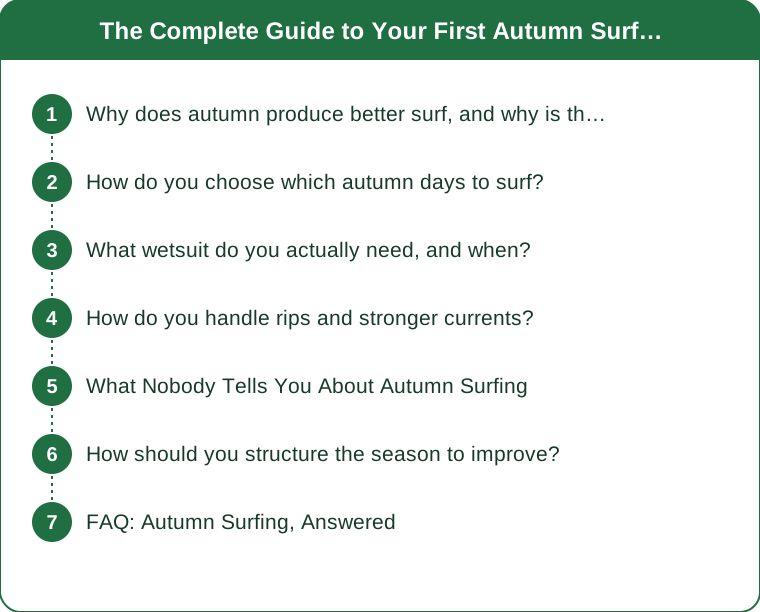
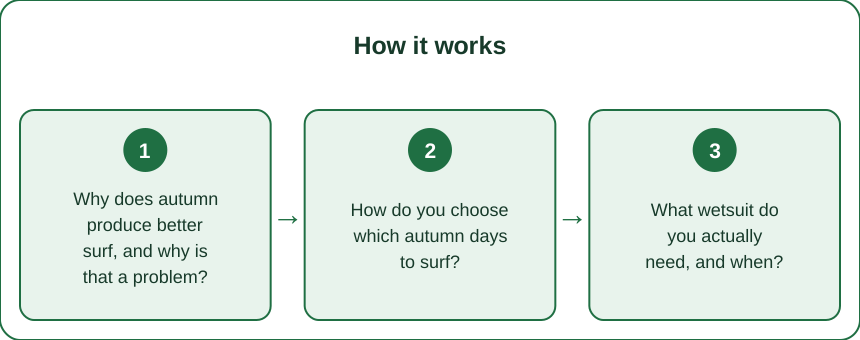
Why does autumn produce better surf, and why is that a problem?
Autumn brings more frequent and more powerful swell to most temperate coastlines, as storm systems increase in energy over cooling oceans.
More swell means more surfable days, which is genuinely why experienced surfers wait all year for it.
It also means more power in each wave, and power is what a beginner is least equipped to handle - a chest-high autumn wave carries considerably more energy than a chest-high summer one.
Wave period is the number that explains this. Longer-period swell carries more energy and breaks harder for the same face height, and autumn swells generally have longer periods than summer wind swell.
Water movement increases with swell size, which means stronger rips and more water shifting along the beach - so the paddle that used to hold you in position no longer does.
Beach shape changes across the season too, as autumn storms move sand and create new banks and channels, so the spot you learned on in July may break entirely differently in October.
The practical consequence is that autumn rewards selectivity. A beginner who surfs the smallest third of autumn days progresses fast. A beginner who surfs whatever is there tends to have one frightening session and then stops.
And crowds thin out considerably, which is a genuine benefit - more waves per person, and more room to make mistakes without consequence to anyone else.
How do you choose which autumn days to surf?
Learn to read a forecast rather than a beach report, because the single number most apps lead with - wave height - is the least informative of the three that matter.
Wave height, wave period, and wind direction together describe a day. Height alone tells you almost nothing about whether it is surfable for you.
Period under about eight seconds is generally wind swell - weaker, messier, and often more beginner-friendly at small sizes. Period above twelve seconds is ground swell, which is cleaner, more powerful, and much harder at the same height.
Offshore wind - blowing from land to sea - holds waves up and cleans them, while onshore wind creates the chop that makes learning miserable.
Light offshore, small height, moderate period is the beginner’s ideal, and autumn produces plenty of those mornings between swells.
Tide changes everything at many spots, and the difference between a low-tide dumping shorebreak and a mid-tide rolling wave is enormous at the same swell size.
Check the forecast the night before and again in the morning, because autumn systems move faster than summer ones and a forecast can change substantially overnight.
And build the habit of walking down to look before you change, since ten minutes of watching tells you more than any app - where people are getting waves, where the water is moving, and whether it is honestly your day.
What wetsuit do you actually need, and when?
A wetsuit works by trapping a thin layer of water that your body heats, which means fit matters far more than thickness - a loose 5mm suit is colder than a well-fitted 4mm.
Thickness is quoted as two numbers, such as 4/3, meaning 4mm through the torso and 3mm in the limbs where flexibility matters.
A 3/2 suit covers most temperate autumn water into September or October, and a 4/3 covers the rest of autumn into winter for most people.
Buy the thicker suit earlier than you think you need it, because being cold is the single most common reason beginners stop surfing in autumn - not fear, not difficulty.
Sealed or taped seams make a substantial difference to warmth compared with flatlock seams, which are effectively summer construction.
Boots come before gloves and a hood for most people, since cold feet arrive first and are the most distracting.
Entry style is worth thinking about - a chest-zip suit generally flushes less water than a back-zip and is warmer, though it is harder to get into.
And rinse it in fresh water and dry it out of direct sun after every session, because neoprene degrades fast with salt and UV, and a suit that lasts three seasons instead of one is the cheapest warmth you will ever buy.

How do you handle rips and stronger currents?
A rip current is water returning seaward through a channel, and autumn swell makes them stronger and more common than in summer.
They are the single most important water-safety concept for a surfer and are frequently misunderstood as something that pulls you under, which they do not - they pull you out.
You can usually see one from the beach as a darker, calmer-looking strip of water where waves are not breaking, often with foam or sediment moving seaward through it.
If you are caught in one, do not paddle straight against it. Paddle parallel to the beach to exit the channel, then use the breaking waves to come back in.
Surfers deliberately use rips to get out past the break, which is a legitimate technique and also the reason it is worth understanding them rather than fearing them.
Stay with your board. It floats, it is visible, and it is the most important safety equipment you have - which is also why a leash in good condition matters more in autumn than at any other time.
Surf near a lifeguarded area where one is operating, and be aware that many beaches reduce or end lifeguard cover in September.
And if in doubt, do not go out. That is not a cliché in autumn - the days you should sit out are much more numerous than in summer, and choosing correctly is a skill in itself. This is general information, not a substitute for qualified surf and water-safety instruction.
What Nobody Tells You About Autumn Surfing
Daylight is the constraint nobody plans for. The after-work session disappears in September, and surfers who do not move to mornings simply stop surfing until spring.
Getting changed is genuinely harder than the surfing, and a proper changing robe plus a bucket of warm water for your feet transforms the experience for very little money.
Cold makes you tired far faster than you expect, so an autumn session should be shorter than a summer one - forty minutes cold is worth more than ninety minutes shivering.
You get worse before you get better in a thicker suit, because the extra neoprene restricts paddling and pop-ups, and this is normal rather than a sign of lost skill.
Autumn line-ups are more experienced, which means the etiquette expectations are higher and the tolerance for dropping in is lower. Learn the rules of priority before you paddle out.
The empty beach is a mixed blessing. Fewer people means more waves and also fewer people to notice if something goes wrong.
Cold water surfing burns a lot of energy, and eating properly before and after matters more than in summer.
A hood makes an enormous difference to how long you last, more than most people expect, because a large share of heat loss is from the head in cold water.
And the first genuinely cold session of the season is always the worst one. Your tolerance builds across a few weeks, so judging the whole season by early October is a mistake.
How should you structure the season to improve?
Set the goal by session count rather than by conditions - aim to be in the water twice a week regardless of how good it is, because consistency is what builds surfing.
Spend the small days on fundamentals. Paddling strength, pop-up speed, and wave selection are all trainable on days too small for anyone else to want.
Do land-based work through autumn, because surfing fitness is largely paddling endurance and thoracic mobility, and both respond well to gym or home work when the sea is unsurfable.
Film one session a month, since almost every beginner’s problem is visible from the beach and invisible from the water.
Have a bad-conditions plan. A swim, a run, or a mobility session on days you cannot surf keeps the habit from breaking, and the habit is what survives winter.
Get one lesson in autumn even if you had lessons in summer, because the conditions are different enough that coached wave selection is worth more now than it was then.
Keep the equipment appropriate to your level. Autumn is when beginners are most tempted to move to a shorter board, and it is the worst season to do it - volume is what catches waves, and catching more waves is what improves you.
And expect a plateau. Autumn improvement is usually invisible for six weeks and then arrives all at once, which is precisely the point at which most people would have quit. This is general information, not a substitute for qualified instruction.
FAQ: Autumn Surfing, Answered
Is autumn a bad time to learn to surf?
No - it is the best time for waves and a demanding time for conditions. Choose the smallest days deliberately and it is an excellent learning season.
What wetsuit thickness do I need for autumn?
A 3/2 for early autumn and a 4/3 for later in most temperate regions, plus boots. Fit matters more than thickness.
Why do autumn waves feel so much stronger?
Longer swell periods carry more energy, so an autumn wave of the same height breaks considerably harder than a summer one.
How do I spot a rip current?
A darker, calmer strip where waves are not breaking, often with foam or sand moving seaward. Paddle parallel to the beach to exit, never straight against it.
Should I get a smaller board now that I can stand up?
Not in autumn. Volume catches waves, and catching more waves is what improves you. Downsize in a gentler season.
How long should an autumn session be?
Shorter than summer - around forty minutes of quality beats ninety minutes of shivering, and cold fatigue arrives faster than you expect.
What is the most common reason beginners quit in autumn?
Being cold, not being scared. An adequate wetsuit, boots, and a changing robe solve most of it. This is general information, not a substitute for qualified surf instruction.
TL;DR:
- Autumn brings the year’s most consistent swell and the smallest margin for error; the surfers who improve are the ones who choose days selectively.
- Read wave period and wind direction, not just wave height - longer period means much more power at the same size.
- Upgrade the wetsuit earlier than feels necessary and add boots; being cold, not being scared, is what ends beginner seasons.
- Learn to identify and exit a rip before you need to: paddle parallel to the beach, never straight against it, and stay with your board.
- Keep the high-volume board, aim for session count rather than perfect conditions, and expect improvement to arrive all at once after a flat six weeks.
The waves get better and the water gets colder in the same month. Plan for both and autumn becomes the season you actually learn to surf. This is general information, not a substitute for qualified surf and water-safety instruction.
Keep Reading
This article is for general informational and styling purposes only. Fit, sizing, and product availability may vary.