Caught Inside: What to Do When a Set Breaks on Top of You
Quick Answer: Caught inside means a set of waves is breaking between you and safety, and each one is about to land on or near you. The script: stay calm, decide early for each wave — push through, turtle roll, or bail with your board controlled — protect your head coming up, breathe in the gaps, and stop trying to make progress until the set passes. Hold-downs feel enormous and last seconds. Panic, loose boards, and burned-out arms are the real hazards, and all three are preventable.
Here is what is happening, and the wave-by-wave playbook.

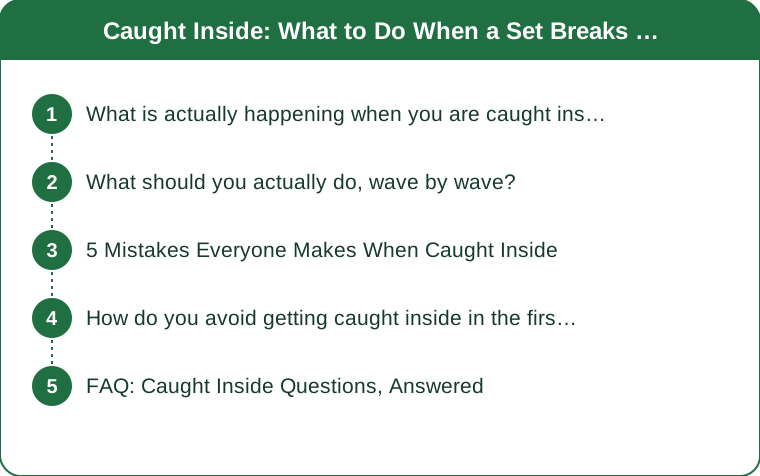
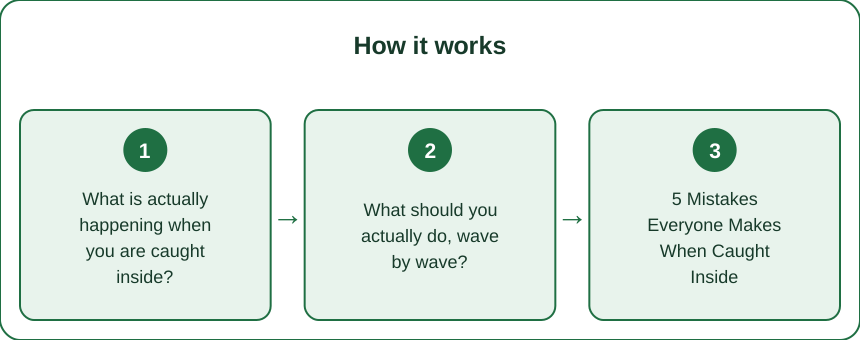
What is actually happening when you are caught inside?
A predictable event that feels like an emergency.
Waves arrive in sets — groups of larger waves separated by lulls. Beginners usually get caught because they started paddling out during a lull, the ocean looked manageable, and the next set arrived while they were still inside the impact zone. This is not bad luck; it is the standard way it happens to everyone.
The impact zone is where the wave throws its energy down, and it is the worst place to be — which is useful, because it means your job is simply to not be there: get past it, or wait safely inside it while the set spends itself.
The numbers are more comforting than the feeling. A typical hold-down from a beginner-sized wave lasts a handful of seconds. Even a genuinely bad one at a beginner break is far shorter than it feels, and the wave itself moves past you and is gone. What runs out first in a caught-inside situation is almost never air — it is composure, then arm strength.
The white water is aerated and shallow-running. Foam is water full of bubbles; it pushes you hard but holds you briefly. Its force also drops fast with depth, which is the entire basis of the escape techniques.
Sets end. Three to six waves, then a lull. The whole strategy of being caught inside is spending as little energy as possible until that lull arrives, then using it.
What should you actually do, wave by wave?
Pick one of three responses early, commit, and breathe between waves.
If the wave has already broken and the white water is modest: push through or over it. On a longboard in small foam, grip the rails, lean your chest, and let it shove you back a little. Losing ground is fine. Fighting to hold every metre is how arms burn out.
If the white water is solid: turtle roll. Flip upside down with the board on top of you, grip the rails, pull the nose slightly down toward you, and let the wave wash over the hull. Roll back up, reset, keep breathing. This is the longboard answer to everything you cannot push through, and it is worth practising on small days until it is boring.
If the wave is about to break on you and the roll will not survive it: bail — properly. Look behind you first to confirm nobody is inside you, push the board away to the side, and go under feet-first or in a shallow dive with your arms leading. Get a lungful before you go, drop low, and let the violence pass above. A bailed board becomes a missile on a nine-foot string — the look-first habit is what makes bailing acceptable rather than dangerous.
Coming up: hands first. Surface with an arm over your head and face protected, because your board is somewhere on your leash and it comes back toward you. Grab it, point it at the next wave, and choose again.
Between waves, exhale fully and breathe deliberately. Two calm breaths beat six panicked ones. Shallow gasping is how composure unravels.

5 Mistakes Everyone Makes When Caught Inside
1. Ditching the board without looking. The single most dangerous act in beginner surfing is not a wave — it is a loose board swinging on a leash near someone’s head. One glance behind before you bail is a non-negotiable habit from day one.
2. Sprint-paddling in a panic between waves. Burning your arms flat-out into the impact zone means meeting the next wave exhausted, which is exactly the state you cannot afford. Move with purpose in the gaps, but save something for the duck-or-roll.
3. Fighting for the surface instantly. Clawing upward against churning foam wastes air against water that is still moving. Stay loose for a beat, let the turbulence release you, then swim up. The wave is finished with you sooner than your adrenaline believes.
4. Holding a huge breath early and gasping late. Hyperventilating before a wave and breath-holding at the top of a panicked lungful spends your calm before the water arrives. Exhale, take one normal deep breath as the wave gets close, and let it be enough — because it is.
5. Refusing to lose ground. Beginners defend every metre of progress like the paddle-out is a score. Drifting back ten metres while a set passes costs thirty seconds; fighting it costs your arms for the whole session. The ocean is not keeping track.
How do you avoid getting caught inside in the first place?
Watch longer, count sets, and use the ocean’s own exits.
Give the lineup ten full minutes before you enter. Count the waves in a set, time the lulls, and watch where the bigger sets break compared with the average ones. The single biggest difference between surfers who rarely get caught and surfers who always do is that one group watched first.
Start your paddle the moment a set ends, not when the water merely looks calm. A lull that just began is an open door; a calm patch of unknown age is a trap. If you watched a full cycle, you know which one you are looking at.
Use the channel. Most breaks have a deeper lane where waves rarely break — often a rip current heading out. Experienced surfers ride it out on purpose. Learn to spot the darker, rippled, foam-carrying strip from the beach, use it for the paddle, and exit it sideways when you are outside the break.
Late summer adds one more reason to be careful: people. August lineups across the US are the year’s most crowded, and a caught-inside beginner in a crowd is managing other people’s loose boards as well as their own. Pick the emptier peak over the better-looking one for now — the skill practice is the same and the hazard is halved.
And build the one fitness that changes everything: relaxed breath under mild stress. Comfortable swimmers make calm surfers. A couple of pool sessions of easy underwater swimming — never alone, never pushing blackout games — raises your composure more than any surf tip.
If conditions make your stomach drop on the beach, that is information. There is no session so good it is worth surviving rather than surfing.
FAQ: Caught Inside Questions, Answered
How long does a hold-down actually last?
At beginner breaks, a few seconds — the wave passes over you and moves on. It feels five times longer because adrenaline distorts time. The practical answer is: shorter than one comfortable breath, which is why calm matters more than lung capacity.
Should I take my leash off so the board cannot hit me?
No. The leash is what keeps your flotation within reach and stops your board hitting everyone else. The answer to board danger is controlling the bail — look behind, push it aside, protect your head surfacing — not removing your only piece of safety equipment.
Is it better to go under the wave or over it?
On a longboard in real white water, under — via a turtle roll — beats trying to climb foam that will throw you backward. Small, spent foam you can push through or over. The skill is judging early and committing.
What if I am too tired to paddle back out?
Then you are done for now, and that is a good decision, not a failure. Ride the white water in on your belly, rest on the beach, and watch the sets while you recover. Fatigue is when boards and rocks find people.
TL;DR:
- Caught inside is a normal, predictable event: a set arrives while you are in the impact zone, and each wave needs one early decision — push through, turtle roll, or a controlled bail.
- Look behind before you ever ditch the board, protect your head surfacing, and breathe deliberately in the gaps; hold-downs last seconds, composure is the real resource.
- Do not defend ground during a set — drift, wait, then use the lull and the channel to get outside.
- Watch the water for ten minutes before entering, count the sets, and pick empty peaks in crowded late-summer lineups.
Rehearse the script on the beach before your next paddle-out. The decision you make calmly on sand is the one you will reach for in the foam.
Keep Reading
This article is for general informational and styling purposes only. Fit, sizing, and product availability may vary.