The Complete Guide to Your First Session on a Shorter Board
Quick Answer: Dropping board length costs you paddle speed, stability and wave-catching ease all at once, and gains you turning ability you cannot yet use. The transition works when you drop volume gradually — roughly five to eight litres at a time — and when you move your paddling position further back and your take-off timing later. Expect two to four sessions of catching almost nothing. That is the transition working, not you failing.
Most people go too short too fast and then blame their ability.
This blog has covered why board volume rather than skill level determines your progression rate, why your arms give out before your legs do, and the complete guide to fin setups. This one puts the whole transition in order.
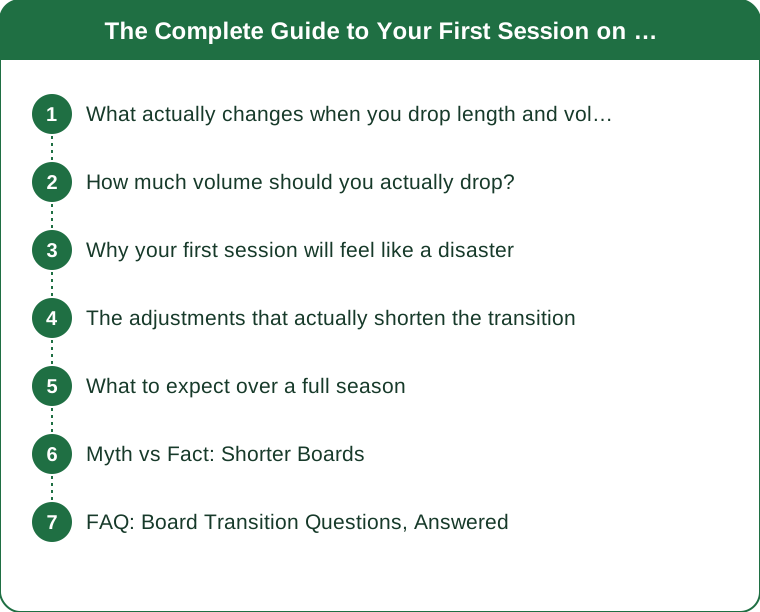
What actually changes when you drop length and volume?
Six things change at once, which is precisely why the first session feels like starting over.
Paddle speed drops immediately. A longer board with more volume glides between strokes; a shorter one decelerates the moment your hand leaves the water. You will paddle harder for less distance, and this is the single largest difference.
The wave-catching window narrows dramatically. A longboard catches a wave from well behind the peak because it planes early. A shorter board needs the wave to be steeper before it will take you, which means paddling later, closer to the peak, and committing harder.
Stability under your feet disappears. Volume is buoyancy, and buoyancy is what forgives a pop-up that lands slightly off centre. Less volume means the board sinks under a mistake rather than absorbing it.
Your paddling position shifts back. The sweet spot on a shorter board is further back than instinct suggests, and it is a narrower window — a few centimetres either way and you are either nose-diving or pushing water.
Duck diving becomes possible, and necessary. A board you can push under changes how you get out the back entirely, but it is a skill you will not have on day one.
And turning becomes available. The board will now go where you point it, with more response than you are used to. This is the whole reason for the change, and it is the last benefit you will actually access.
The order matters: you lose three things immediately and gain one thing gradually. Planning for that gap is what separates a smooth transition from a demoralising one.
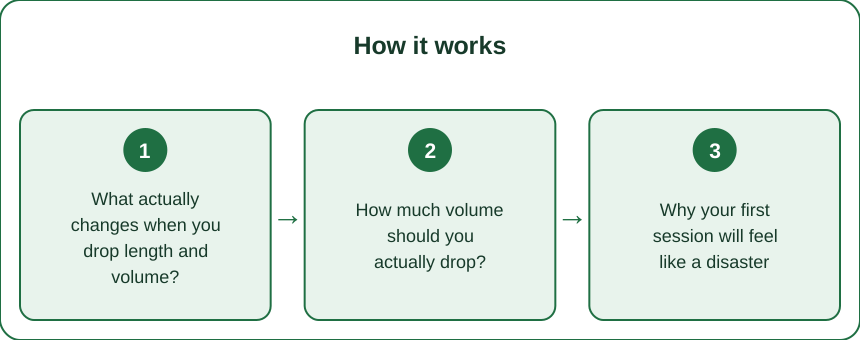
How much volume should you actually drop?
Less than you want to, and in steps rather than in one jump.
Volume, not length, is the number that matters. A shorter board with a thick, wide outline can carry more volume than a longer thin one, and volume is what determines float and paddle ease.
A reasonable rule for intermediate surfers is roughly your body weight in kilograms multiplied by 0.5 to 0.7 for a comfortable everyday board. Beginners want the upper end or above it; experienced surfers ride well below it.
Drop five to eight litres per step, not fifteen. A jump that large removes your ability to catch waves at all, and you cannot practise turning on waves you never catch.
Spend at least a full season at each step. The goal is to be catching waves easily and turning confidently on the current board before you go shorter. If you are still fighting to get to your feet, you are not ready.
Consider a mid-length as the intermediate step. A seven to eight foot board with generous volume catches waves nearly as easily as a longboard and turns far more like a shortboard, which makes it the most useful transitional shape available.
Width and thickness matter as much as length. A shorter board with a wide tail and a full outline is a far gentler transition than a narrow performance shape of the same length.
Wave count is the currency of progression. A season on a board that catches waves easily gives you more pop-up repetitions, more time reading the face, and more rides to learn from than a season on a board that looks better in the car park. Every litre you drop costs you some of that, which is why the steps need to be small enough that your wave count recovers within a few sessions.
And be honest about how often you surf. Someone surfing twice a week can drop volume faster than someone surfing twice a month, because skill retention between sessions is the limiting factor. Infrequent surfers should stay on more volume than the charts suggest.
Why your first session will feel like a disaster
It follows a predictable script, and knowing the script makes it survivable.
You will miss waves you would have caught easily. Not a few — most of them. The paddle-in timing you have built over months is calibrated to a board that planed earlier, and that calibration is now wrong.
Your arms will burn far sooner. More of the paddling effort now goes into keeping the board moving rather than into moving forwards, and your shoulders will notice within twenty minutes.
You will nose-dive. Repeatedly, and in situations where your old board simply would not have. Your position is too far forward, and correcting it feels like you are sitting too far back.
Your pop-up will feel unstable even when you make it. There is less board under your feet, and less buoyancy to forgive a landing that is slightly off.
And you will be tempted to go back. Most people who abandon the transition do so in the first two sessions, which is exactly the point at which nothing has adapted yet.
Give it four sessions minimum before you judge it. The change from session one to session four is usually larger than the change over the following month.
The adjustments that actually shorten the transition
Seven specific changes, all of which you can apply on the first session.
Move back on the board. Find the position where the nose sits one to two inches clear of the water when you are lying still. Mark it with a wax line if you need to; guessing costs you waves.
Start paddling earlier and finish harder. You need more speed at the moment of take-off, and you need to still be paddling when the wave picks you up rather than gliding.
Take off closer to the peak. The steeper part of the wave gives the board the gradient it now needs. This feels more committing because it is.
Chase down the take-off with two extra strokes. The single most common failure is stopping paddling at the moment the old board would have caught it.
Pop up faster and further back. Your front foot lands closer to the middle of the board than it used to, and hesitating on the chest is far more costly with less volume under you.
Pick smaller, cleaner days to start. The transition is a technique problem, and a messy overhead day is the worst possible classroom.
And do the paddle conditioning on land. Two sessions a week of pulling movements, rows and prone shoulder work makes a measurable difference within a month, and paddling is now your limiting factor rather than your balance.
What to expect over a full season
The curve is uneven, and knowing the shape prevents most of the frustration.
Sessions one to three: catching very little. This is the adaptation period and there is no way around it. Focus entirely on paddle position and take-off timing rather than on riding.
Sessions four to eight: waves start coming back. You will begin catching a reasonable proportion again, and the pop-up will start feeling normal. Turning is still ahead of you.
Sessions eight to fifteen: the board starts giving something back. You will feel the board respond to weight shifts in a way the old one never did, and this is the first point at which the change feels worthwhile.
Beyond that: the board becomes the reason you improve. Responsiveness that felt like instability now reads as feedback, and progression accelerates noticeably.
Keep the old board. Small days, bad conditions and low-energy sessions are all better on more volume, and having both is not a failure of commitment. Most experienced surfers own several boards precisely for this reason.
And track your wave count, not your best ride. Waves caught per session is the metric that actually shows the transition progressing, and it improves steadily even in sessions that feel bad.
Myth vs Fact: Shorter Boards
Myth: A shorter board will make you a better surfer. Fact: It will expose what you cannot yet do and give you tools you cannot yet use. Skill drives board choice, not the reverse. Going shorter before you are ready slows progression by cutting your wave count.
Myth: Length is what matters. Fact: Volume is what matters. A six-foot board at forty litres floats and paddles better than a seven-foot board at thirty. Compare volumes, not lengths, when you shop.
Myth: You should be able to catch waves on any board if you are fit enough. Fact: Paddle fitness helps and it does not replace planing surface. A board below your volume range will not plane early enough regardless of how strong your shoulders are.
Myth: A performance shortboard is the goal for everyone. Fact: It is the goal for people surfing steep, powerful, well-formed waves regularly. For most surfers on most beach breaks, a mid-length catches far more waves and produces far better sessions.
Myth: If you are still nose-diving, you need a bigger board. Fact: Usually you need to move back a few centimetres. Position accounts for more nose-dives than volume does, and it is free to fix.
Myth: Autumn is a bad time to change boards. Fact: It is often the best time. Cleaner, more consistent swell and fewer people in the water give you the wave count that a transition requires — provided you have the wetsuit for it.
FAQ: Board Transition Questions, Answered
How much volume should I drop when going to a shorter board?
Five to eight litres per step, with at least a season at each one. Larger jumps remove your ability to catch waves, and you cannot develop turning on waves you never catch.
How long does it take to adapt to a shorter board?
Expect two to four sessions of catching very little, eight or so before it feels normal, and around fifteen before the board starts genuinely giving you something the old one could not. Frequency matters more than total time.
Should I go straight from a foam board to a shortboard?
No. A mid-length or a funboard in between is what makes the transition work. Jumping straight to a performance shortboard cuts your wave count so severely that most people stop improving entirely.
Why do I keep nose-diving on my new board?
Almost always because you are lying too far forward. The sweet spot moves back as boards get shorter. Aim for the nose sitting an inch or two clear of the water when you are lying still.
TL;DR:
- Volume, not length, is the number that determines float, paddle speed and wave-catching ease. Compare volumes when you shop.
- Drop five to eight litres per step and spend a full season at each one.
- You lose paddle speed, stability and wave count immediately; you gain turning ability only after weeks. Plan for that gap.
- Move back on the board, paddle later and harder, and take off closer to the peak. Position fixes most nose-dives.
- Keep the old board. Small days are better on volume, and owning both is normal.
The transition is not a test of whether you deserve a shorter board. It is a set of adjustments, and it takes about a season.
Keep Reading
This article is for general informational and styling purposes only. Fit, sizing, and product availability may vary.