How to Read Surf Conditions Before You Paddle Out (A Complete Guide)
Quick Answer: Before paddling out, spend a full 10-15 minutes watching the water from the beach — wave size, interval, current direction, and crowd behavior all tell you more than a quick glance ever will. Skipping this step is the single biggest predictor of a rough, exhausting, or unsafe session.
New surfers tend to treat the walk from the parking lot to the water as the whole preparation process. Experienced surfers spend real time on the sand first, and that difference explains a lot of why some sessions feel manageable and others feel like a fight from the first paddle stroke.

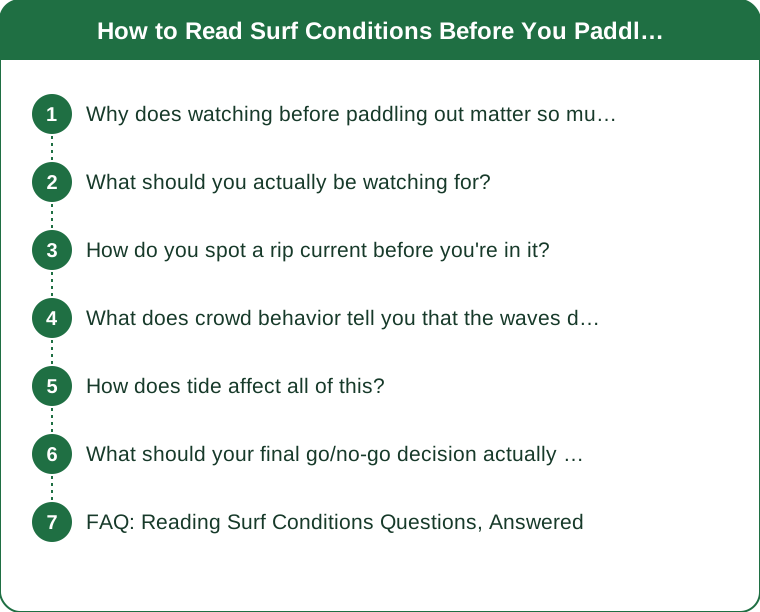
Why does watching before paddling out matter so much?
Because ocean conditions are rarely uniform or obvious from a single glance — wave sets come in groups with lulls between them, currents shift along a beach, and what looks like a calm moment can be the gap before a larger set arrives. A quick look catches none of that.
A full set cycle usually takes several minutes to complete, so watching for at least one full cycle — ideally two — before entering the water gives you real information instead of a guess. This single habit prevents more bad sessions than any piece of gear or technique.
Experienced surfers aren’t naturally more patient; they’ve simply learned that the 10-15 minutes on the sand pays for itself many times over once you’re actually out there.
What should you actually be watching for?
Wave size and shape: Watch several waves break in the same general area. Are they closing out all at once (bad for beginners) or peeling in one clean direction (rideable)? Consistency matters more than any single wave’s size.
Set interval: Time the gap between wave sets with your phone if needed. A longer interval means more recovery time between paddling efforts; a short, relentless interval is significantly more tiring and harder to time your paddle-out around.
Where other surfers are sitting: Experienced local surfers position themselves in the best takeoff spot almost every time — their lineup position is often the single fastest way to identify where the good waves are actually breaking, faster than trying to read the wave shape yourself as a beginner.
Taken together, these three observations tell you far more about the actual session ahead than the overall wave height number ever will on its own.
How do you spot a rip current before you’re in it?
Look for a channel of water that appears calmer, more choppy, or a different color (often browner or more turbid from stirred-up sand) than the water around it, usually running perpendicular to the shore. Foam or debris moving steadily seaward in a visible line is another strong signal.
Once you’ve identified one, note its position relative to a fixed landmark on the beach — rips can actually be useful for a faster paddle out if you’re experienced, but for most surfers, especially beginners, the safer move is simply to note the location and paddle out well clear of it.
If you’re ever caught in one: don’t fight it directly. Swim parallel to shore until you’re out of the current’s pull, then angle back in. This single piece of knowledge has saved more swimmers and surfers than any other single safety tip.

What does crowd behavior tell you that the waves don’t?
A packed lineup with surfers visibly frustrated, snaking priority, or bailing frequently signals conditions that are harder to manage than they might look from the beach — inconsistent, closing-out, or crowded past a comfortable point. A sparse, relaxed lineup where surfers are catching clean rides in turn suggests more manageable, better-organized conditions.
This is especially useful information for less experienced surfers, since crowd behavior often reflects local knowledge about factors — a shifting sandbar, an underwater hazard, a better break just around a point — that aren’t visible from a first look at the water itself.
Don’t discount the value of simply asking someone getting out of the water how the session was. Most surfers are willing to share a quick, honest read on conditions, and it’s faster and more reliable than guessing.
How does tide affect all of this?
The same wave and beach can surf completely differently at high tide versus low tide — a spot that’s a clean, gentle beginner wave at mid-tide can turn into a fast, hollow, advanced wave at low tide as the sandbar becomes more exposed, or go flat and mushy at high tide as the water depth increases over the sandbar.
Check a tide chart before you go, and if possible, learn how your specific local spot behaves across the tide cycle — this local knowledge often matters more than the general wave height forecast for the day.
As a rough starting rule for beginners: a rising, mid-tide period is often the most forgiving window at many beach breaks, though this varies significantly by specific location and should be verified against local knowledge rather than assumed universally.
What should your final go/no-go decision actually weigh?
Combine everything: if wave size matches your skill level, the interval gives you real recovery time, the lineup looks organized rather than chaotic, you’ve identified any rip currents and noted their position, and the tide is in a stage you know works for that spot — that’s a genuine go decision, not just an optimistic one.
If two or more of those factors look questionable, it’s a completely legitimate choice to wait, watch longer, or pick a different, more sheltered spot for that day. Skilled surfers say no to sessions far more often than beginners assume — reading conditions well includes knowing when the honest answer is not today.
This is general safety information, not a substitute for local knowledge, lifeguard guidance, or a surf lesson with a qualified instructor, especially if you’re new to a specific break.
FAQ: Reading Surf Conditions Questions, Answered
How long should I actually watch before paddling out?
At minimum one full set cycle, which is often 10-15 minutes depending on the spot — two cycles gives you a more reliable read, especially at an unfamiliar break.
What’s the single most important thing to watch for as a beginner?
Where other surfers are sitting in the lineup — it’s the fastest, most reliable shortcut to understanding where waves are actually breaking well.
Should I trust a surf forecast app over my own observation?
Use the app for general planning (swell direction, size, timing), but always confirm with your own eyes at the beach — forecasts don’t account for local sandbar conditions, current crowd behavior, or how a specific spot is breaking that exact day.
TL;DR:
- Watch a full set cycle (10-15+ minutes) from the beach before paddling out
- Wave consistency, set interval, and lineup positioning tell you more than wave height alone
- Identify rip currents by their calmer, discolored channel and note their location
- Crowd behavior reflects local knowledge you can’t see from the water alone
- Tide stage can change the same spot from beginner-friendly to advanced within hours
Ten extra minutes of watching from the sand is the cheapest insurance in surfing — this is general information, not a substitute for local knowledge or a qualified instructor.
Keep Reading
This article is for general informational and styling purposes only. Fit, sizing, and product availability may vary.