The Complete Guide to Surf Fitness Off the Water — What to Train the Weeks You Can't Paddle Out
Quick Answer: Off-water surf fitness should prioritize shoulder endurance for paddling, rotational core strength for pop-ups and turns, and hip mobility for the crouched surf stance — in that order — since paddling fatigue, not wave-reading skill, is what actually limits most surfers during a session.
Every surfer eventually hits a stretch without waves — a flat spell, an injury, a move inland, a stretch of winter storms that make the lineup unfishable. The surfers who come back strongest treat that time as training, not just waiting.
This is the full breakdown of what actually transfers to the water, broken into the systems that matter most, in the order they matter most.

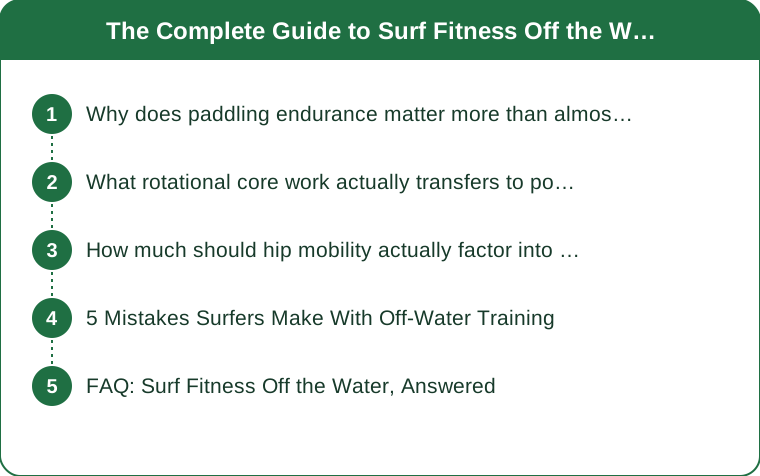
Why does paddling endurance matter more than almost anything else?
Most surfers don’t lose waves because they can’t read conditions or pop up fast enough — they lose waves because their shoulders and upper back fatigue during the paddle out and the paddle for the wave itself, long before the actual ride. A tired paddle arm arrives late to a wave that was catchable, or arrives too gassed to generate speed into the pop-up.
Building paddling-specific shoulder endurance is the single highest-value thing you can train off the water. That means high-rep, moderate-load work — think resistance band pulls, prone Y-T-W raises, and swimming freestyle sets — rather than heavy, low-rep shoulder pressing, which builds a different kind of strength than the sustained, repetitive pulling paddling requires.
A simple, effective structure: 3 sets of 15-20 reps of banded rows, prone Y-raises, and freestyle swim intervals, 2-3 times a week. The volume matters more than the load here — you’re training your shoulders to fire for minutes at a time, not seconds.
What rotational core work actually transfers to pop-ups and turns?
Pop-ups and bottom turns both rely on rotational power through the torso, not just raw ab strength. Standard crunches barely touch the muscles doing the real work in a turn.
Cable or band rotations, medicine ball throws, and Russian twists with a weighted ball train the same rotational chain your obliques and deep core use to snap into a pop-up or drive through a turn. Aim for explosive, controlled reps — 3 sets of 10-12 per side — rather than slow, high-rep sets, since the actual movement in surfing is fast and reactive, not sustained.
Pair this with single-leg balance work (single-leg deadlifts, Bosu ball standing holds) since a pop-up lands you on one board with your weight shifting constantly — the same reactive balance a paddleboard or balance trainer builds.

How much should hip mobility actually factor into your training?
The crouched surf stance — knees bent, hips low, weight forward — demands a range of hip flexion and internal rotation that most land-based sitting postures actively work against. Tight hips show up as a stance that feels cramped or unstable rather than low and springy.
Daily hip flexor stretches, 90/90 hip switches, and deep squat holds (even just sitting in a low squat while watching TV) meaningfully improve how comfortable and sustainable your surf stance feels, especially on longer sessions where fatigue tends to collapse your stance upward and backward.
This is lower priority than paddling endurance and rotational core, but it’s the piece most surfers skip entirely — and it’s often why a stance that felt fine for 20 minutes falls apart by minute 40.
5 Mistakes Surfers Make With Off-Water Training
1. Training like a bodybuilder instead of an endurance athlete. Heavy, low-rep lifting builds strength you won’t fully use — paddling and popping up reward sustained, repeatable output more than one-rep max strength.
2. Skipping swimming entirely. Pool laps are one of the most direct paddling-endurance transfers available and are drastically underused by surfers who only lift weights.
3. Ignoring single-leg balance work. Two-legged squats don’t replicate the constant single-board-edge balance surfing demands.
4. Training core with only flexion (crunches). Surfing needs rotational and anti-rotational core strength far more than forward-flexion strength.
5. Doing nothing during a flat spell and expecting to pick up exactly where you left off. Even 2-3 short sessions a week during a break preserves far more fitness than a full stop.
FAQ: Surf Fitness Off the Water, Answered
How many days a week should off-water surf training take?
2-3 focused sessions a week is enough to maintain and even build surf-specific fitness — more isn’t necessarily better if the sessions aren’t targeted at paddling, rotation, and hip mobility specifically.
Can swimming alone replace a full surf fitness routine?
Swimming covers paddling endurance well but doesn’t address rotational core power or hip mobility — it’s a strong piece of the puzzle, not the whole thing.
How quickly do you lose surf-specific fitness during a flat spell?
General fitness declines slowly, but the very specific paddling and pop-up endurance can noticeably drop within 2-3 weeks of total inactivity — which is exactly why targeted off-water training matters during longer breaks.
TL;DR:
- Paddling shoulder endurance matters more than almost any other off-water training priority — train it with high-rep band and swim work
- Rotational core power (not crunches) is what actually transfers to pop-ups and turns
- Hip mobility work is the most commonly skipped piece and often decides how long your stance holds up in a session
- 2-3 focused sessions a week during a flat spell preserves far more fitness than doing nothing
The next flat spell doesn’t have to be a fitness reset — treat it as the training block your surfing has been missing.
Keep Reading
This article is for general informational and styling purposes only. Fit, sizing, and product availability may vary.