Why the Wrong Leash Length Makes Surfing Feel Harder Than It Should
Quick Answer: Match your leash roughly to your board length as the baseline — a 6’0” board takes a 6’ leash. Size down slightly on small, clean days to cut drag, and up (with a thicker cord) for bigger, more powerful surf so the board has room to travel without loading the leash to snapping point. A mismatched leash quietly costs you paddling energy and board control, and almost nobody blames the leash.
Most surfers own one leash. It came with the board, it’s roughly the right length, and it gets used for every session from knee-high summer mush to overhead winter days.
That’s a reasonable default and a genuinely costly one. Leash length changes how your board behaves in the water — while you’re paddling, while you’re duck-diving, and in the critical second after a wipeout.

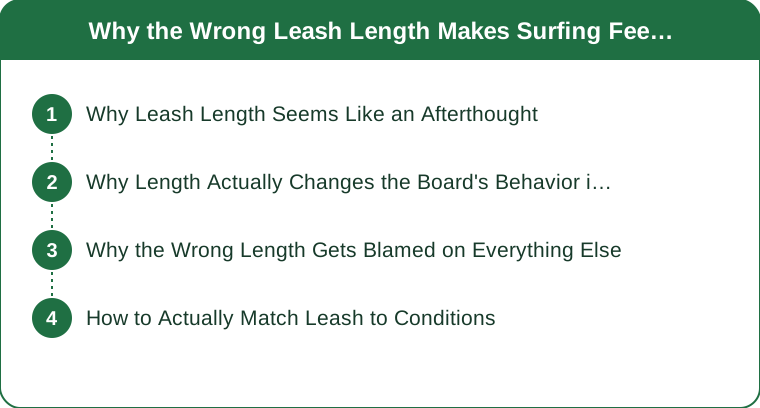
Why Do Most Surfers Ignore Leash Length?
Because a leash reads as a safety accessory rather than a piece of performance equipment.
Boards get obsessed over — volume, rocker, fin setup, tail shape. Wetsuits get chosen by millimetre. The leash gets bought once, replaced when it snaps, and never reconsidered.
The other reason is that its effects are diffuse. A leash doesn’t cause an obvious, traceable problem. It makes paddling slightly harder and wipeouts slightly worse, spread across a two-hour session. That registers as “I was tired today” or “I’m out of shape,” not “my leash is wrong.”
How Does Leash Length Change Board Behaviour?
Two distinct problems, at opposite ends.
A leash that’s too long gives the board room to build momentum before the cord goes taut. After a wipeout, the board travels further and accelerates more before the leash stops it — and then it snaps back toward you with more energy. A longer leash also means more cord in the water, which means more drag and more tangling around your ankle and fins.
The recoil is the real issue. That’s how boards hit people, and the extra travel distance is exactly what converts a nuisance into an injury.
A leash that’s too short keeps near-constant tension between your ankle and the tail. That tension is a small, continuous drag load while paddling — and paddling is where most of your energy goes in a session. It also fouls duck-diving, because the board can’t extend away from you properly as you push it under.
Short leashes bring the board back faster after a fall, too, which sounds good and isn’t when the wave is big enough that you want the board away from you while you’re still underwater.

Why Does the Wrong Leash Get Blamed on Everything Else?
Because the symptoms it produces look exactly like fitness and skill problems.
You’re tired earlier than you should be — so you blame your paddling fitness. Your board keeps ending up in awkward places after falls — so you blame your wipeout technique. Duck-dives feel sticky — so you blame your timing.
All three can be a leash. None of them will ever be diagnosed as one, because the leash is the last thing anyone examines. It’s the piece of kit that gets attention only when it breaks.
The tell: if the same board feels noticeably better or worse on days when you’ve borrowed someone’s leash, that’s your answer.
How Do You Match a Leash to Conditions?
The baseline rule: leash length ≈ board length, rounded up. A 6’0” shortboard takes a 6’ leash. A 9’ longboard takes a 9’ or 10’ leash. This is the sizing that works across most conditions and is the right default if you own one leash.
From there, adjust for the day:
Small, clean waves (waist-high and under) — you can go slightly shorter than board length. Less cord means less drag, and there’s little power in the water to justify the extra distance. A 6’ board on a 5’6” leash on a clean summer day is a real, noticeable difference in paddling ease.
Everyday conditions (waist to shoulder-high) — match board length. Don’t overthink it.
Bigger, more powerful surf (overhead and up) — go slightly longer and thicker. The extra length gives the board room to travel and the wave room to move you both without loading the leash to its breaking point. The thicker cord — often called a “comp” versus “regular” versus “big wave” gauge — is the more important variable here, and a snapped leash in serious surf is a genuinely dangerous situation.
Also check the cord thickness for your everyday leash. Thin competition leashes have less drag and are noticeably more likely to break. That’s a fine trade in small waves and a poor one in powerful ones.
Practical setup notes:
- Ankle for shortboards, calf for longboards. A calf strap keeps the cord clear of the rails when you’re walking the board.
- Wear the cuff on your back foot, with the cord exiting behind your heel so it trails away from you.
- Check the swivels and the rail saver every few sessions. Most leash failures start at the swivel, not in the middle of the cord.
- Replace leashes annually if you surf regularly. UV degrades urethane and the failure is usually sudden.
FAQ
Does leash thickness matter more than length?
For safety in bigger surf, yes. Thickness determines breaking strength, and a snapped leash in powerful waves means a long swim and a loose board in the lineup. For paddling efficiency in small waves, length and drag matter more.
Should I own more than one leash?
If you surf a wide range of conditions, two is worth it — a thinner, slightly shorter one for small clean days and a thicker, slightly longer one for bigger surf. They’re inexpensive relative to everything else in surfing.
Why does my board keep hitting me after wipeouts?
Most often a leash that’s too long for the conditions, letting the board accelerate before the cord goes taut and recoils. Falling flat and shallow rather than diving deep, and covering your head as you surface, both help too.
TL;DR:
- Baseline: leash length roughly matches board length
- Too long = board builds momentum, recoils harder, adds drag and tangles
- Too short = constant tension, drag while paddling, bad duck-dives
- Small clean days: slightly shorter. Big surf: slightly longer and thicker
- Cord thickness is the safety variable — thin comp leashes break
- Symptoms read as fatigue or bad technique, so the leash never gets blamed
- Check swivels regularly and replace annually if you surf often
Keep Reading
This article is for general informational and styling purposes only. Fit, sizing, and product availability may vary.