Why Autumn Is the Best Time to Learn to Surf, and What Makes It Harder
Quick Answer: Autumn gives beginners better waves, warmer water, offshore mornings, and empty lineups - the four things that most limit progress in summer. What it takes away is daylight, comfort, and margin for error, and it adds swell that can exceed beginner ability quickly. Learn the conditions and autumn is the fastest-progress season of the year.
You spent July and August in waist-deep whitewater, standing up occasionally, and concluded that surfing was going to take years.
Meanwhile every surfer you asked said the same odd thing: wait until the autumn. It sounds like the opposite of sensible advice - colder water, bigger waves, shorter days - and it is the most useful thing anyone will tell you about learning this sport.


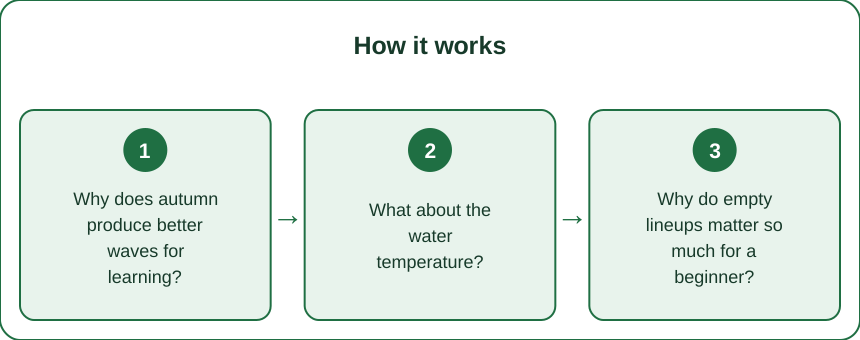
Why does autumn produce better waves for learning?
Because summer waves are mostly bad waves, and beginners are taught in them anyway.
A summer beach break is typically fed by weak, short-period local windswell. That produces waves that are small, disorganised, and crumbly, arriving in short irregular sets with no clear shape. For a beginner that means the whitewater is inconsistent, the waves break unpredictably, and there is nothing to read - which is exactly the wrong environment for building the pattern recognition that surfing actually consists of.
Autumn brings longer-period groundswell generated by distant storms. Longer period means the waves arrive in organised sets with consistent spacing, break in a predictable place, and hold their shape as they do. A well-organised three-foot autumn wave is dramatically easier to learn on than a messy two-foot summer wave, even though it is bigger, because it does the same thing every time.
Predictability is what a beginner needs above all else. You cannot learn to read a wave that behaves differently every time.
There is also more energy in the wave, which matters more than people expect. A weak summer wave does not have enough push to get a beginner board moving until you are already in the steepest part, so the timing window for catching it is tiny. A groundswell wave picks the board up earlier and carries it longer, which forgives an enormous amount of imperfect paddling and timing. The same pop-up attempt that failed all summer suddenly works, and it is the wave that changed rather than the technique.
And the sets are readable. Waves arriving in groups with lulls between them means there is a rhythm to the session - you can paddle out in the lull, you can wait knowingly, you can see the set coming. Summer gives you a constant low-grade churn with no structure to learn from.
What about the water temperature?
This is the part almost every beginner gets exactly backwards, and it costs people entire seasons.
Ocean water lags air temperature by roughly two months because water has enormous thermal mass. It takes all summer to warm up, and it does not peak until late August or early September. The warmest ocean water of the entire year, at most US latitudes, arrives after Labor Day.
So the September and October surfer is in warmer water than the July surfer, with the added benefit of the good swell having arrived. Water that was 62F in June is commonly 70F in September on the same beach.
The air is cooler, which is why it feels colder standing on the beach, and that perception is what drives people home. It is worth being precise about this: the walk to the water and the change afterwards are colder, and the surfing itself is warmer.
Practically, this means autumn requires a change of kit rather than a change of season. A shorty or a 3/2 wetsuit through September and October covers most US coastlines comfortably, and a changing robe on the beach handles the part that is genuinely colder. Those two items extend a learning season by two to three months, which for a beginner is the difference between a summer of frustration and a year of real progress.
The other thing worth knowing is that a wetsuit helps beginners for reasons beyond warmth. It adds buoyancy, it protects your ribs and hips from a hard board, and it removes the rash that makes the second session of a weekend miserable.
Why do empty lineups matter so much for a beginner?
Because crowds do not just make surfing less pleasant. They actively prevent learning.
In a busy summer lineup, a beginner spends most of their energy on avoidance. You are watching for people, checking whether a wave is taken, worrying about dropping in, apologising, and repositioning. Almost none of that attention is available for the actual skill.
You also get fewer waves, and the ones you get are the leftovers. Surfing is learned by repetition of the take-off, and take-off attempts per hour is the single most useful measure of a learning session. A crowded summer beach might give a beginner eight or ten attempts an hour. An empty autumn weekday morning can give thirty.
That is a three-fold difference in learning rate, and it compounds. Three autumn sessions can be worth ten summer ones on this measure alone.
There is a confidence element too. Beginners hold back in crowds, take the safer option, and paddle for fewer waves than they could. Alone or nearly alone, people commit, and committing is most of the skill.
And there is a practical safety point that runs the other way. An empty lineup means fewer people around if something goes wrong, so the autumn beginner needs to be more conservative about conditions and should tell someone where they are. Surfing alone in bigger autumn swell is a different risk profile from surfing alone in a summer crowd, and it deserves respect rather than avoidance.

What makes autumn genuinely harder?
Four things, and they are real. Autumn rewards judgement more than summer does.
Swell size varies far more. Summer swell is reliably small. Autumn swell ranges from perfect beginner conditions to genuinely dangerous within the same week, sometimes within the same day. A beginner who checks the forecast and understands what the numbers mean is fine. A beginner who drives to the beach and paddles out regardless will eventually have a very bad session.
Rip currents strengthen. More swell means more water pushed onto the beach, and that water has to return offshore somewhere. Autumn rips are stronger and more numerous, and they are the main hazard for beginners. Learning to spot one - a channel of darker, calmer, choppier water with less breaking - is the single most important safety skill of the season.
Daylight shrinks fast. Losing several minutes a day adds up quickly, and the after-work session that worked in August is gone by late September. This is a planning problem rather than a surfing one, and it is the reason many people stop - not the cold, but the calendar.
Conditions change within a session. Autumn wind shifts and tides move more consequentially over a two-hour window. A session that starts clean can be blown out by mid-morning, which means checking the forecast is not once a week but the night before and again on arrival.
None of these makes autumn a bad time to learn. They make it a time to learn with more information, which is a skill the sport requires anyway and which summer conditions let you avoid.
What Nobody Tells You About Learning in Autumn
The best sessions are early on weekdays and almost nobody is there. Offshore winds are most common in the early morning as land cools overnight, which produces the clean, groomed waves in every surf photograph. An autumn weekday at 7am is the highest-quality beginner window of the entire year, and it is empty.
Your summer board is probably too small for autumn. People size down as they progress and then hit autumn swell with a board that does not paddle fast enough to get into a steeper wave. Beginners in particular should stay on volume through the autumn rather than dropping down.
Two sessions a week beats one long one. Surfing is largely pattern recognition, and pattern recognition consolidates with frequency, not duration. Two ninety-minute sessions will progress you faster than one four-hour marathon, and the marathon leaves you too tired to learn in the last hour anyway.
The changing robe is the piece of kit that keeps you going. Not the wetsuit, not the board. The thing that ends autumn surfing for most beginners is standing in a car park in a wet suit in a cold wind, and a robe removes that entirely for the price of a couple of lessons.
Nobody in the water is judging your surfing. Every beginner believes the lineup is watching. Experienced surfers are watching the horizon, and the only thing that generates any real irritation is unpredictable positioning rather than lack of skill. Learning where to sit and staying out of the way matters far more socially than how well you ride.
And the first cold session is the hardest one you will ever do. The mental barrier to autumn surfing is almost entirely about the first time. After one session where you were warm enough and got more waves than you did all August, the barrier is gone for good.
How should you actually plan an autumn learning block?
Treat September to early November as a defined block rather than an extension of summer, and set it up once.
Sort the kit before the first session. A 3/2 wetsuit appropriate to your coastline, boots if your water goes below about 60F, a changing robe, and a dry bag. Buying these in a hurry after a cold session is how people end up with the wrong thing.
Keep the volume in your board. A soft-top or a large funboard through this block. There is no benefit whatsoever to being on a smaller board as a beginner, and a great deal of cost - fewer waves, fewer attempts, slower learning.
Learn to read one forecast source properly. Wave height, swell period, and wind direction. Period above about 10 seconds means organised groundswell; offshore or light wind means clean conditions. Two numbers and a direction will tell you most of what you need, and understanding them turns autumn from unpredictable to selectable.
Set a personal ceiling and stick to it. Something like: chest high or under, wind under 10mph, and never alone in anything above waist high. Deciding this at home rather than in the car park is what keeps autumn safe.
Book the early weekday mornings. If your schedule allows even one a week, it will be the session you progress in. Set the alarm the night before and prepare the kit in the evening, because the decision at 6am is not one you want to be making from scratch.
Take a lesson in autumn even if you took one in summer. Instructors are far less busy, the conditions are better, and an hour of coaching in a good wave with a clear head is worth several in a crowded summer whitewater class.
And keep a two-line log after each session. What the forecast said, and how it actually was. Six entries in and you will start predicting conditions yourself, which is the skill that separates people who surf from people who occasionally go surfing.
FAQ: Autumn Surfing Questions, Answered
Is it safe to learn in autumn swell?
With judgement, yes. Choose beaches with lifeguard cover where possible, check the forecast the night before and again on arrival, know how to identify and escape a rip by paddling parallel to shore, and set a size ceiling before you leave home. This is general information rather than personal safety advice, and a lesson with a local instructor is the best way to learn a specific beach.
What wetsuit thickness do I need?
It depends entirely on your coastline. As a rough guide, a 3/2 covers most US surf through September and October, with boots added as water drops toward 60F and a 4/3 beyond that. Local surf shops give better advice than any general rule because they know the actual water temperatures.
Should I keep going through winter?
Many people do, and the progression continues. The kit requirement steps up and the daylight problem gets worse, so it becomes a question of commitment rather than capability. Getting through autumn well is the honest test of whether winter is for you.
TL;DR:
- Autumn groundswell is organised and predictable, which is exactly what beginners need - summer windswell is not.
- Ocean water peaks after Labor Day, so autumn surfing happens in the warmest water of the year despite the cooler air.
- Empty lineups can triple your take-off attempts per hour, and attempts per hour is what drives progress.
- The real costs are shrinking daylight, stronger rips, and variable swell, all of which are managed with a forecast and a personal ceiling.
Most people quit surfing in August, having only ever experienced the worst waves of the year in the most crowded conditions. Buy the wetsuit and the changing robe, keep the big board, learn to read three numbers on a forecast, and give the autumn a proper eight weeks. It is a different sport from the one that frustrated you all summer.
Keep Reading
This article is for general informational and styling purposes only. Fit, sizing, and product availability may vary.