Why Paddling Endurance Determines a Beginner Surfer's Session More Than Pop-Up Speed Does
Quick Answer: Paddling endurance decides how many waves you actually get, because you have to reach the wave before the pop-up matters at all. Beginners over-train the pop-up because it’s the visible, coachable moment — but roughly 90% of time in the water is spent paddling. Shift training toward paddling endurance and total wave attempts go up immediately.
The pop-up gets all the attention. It’s the dramatic moment, it’s what the instructor can see, and it’s what you practice on the sand for twenty minutes before you go out.
Then you paddle for two hours, catch four waves, and go home with arms like overcooked noodles.
The pop-up wasn’t your limiting factor. It never was.
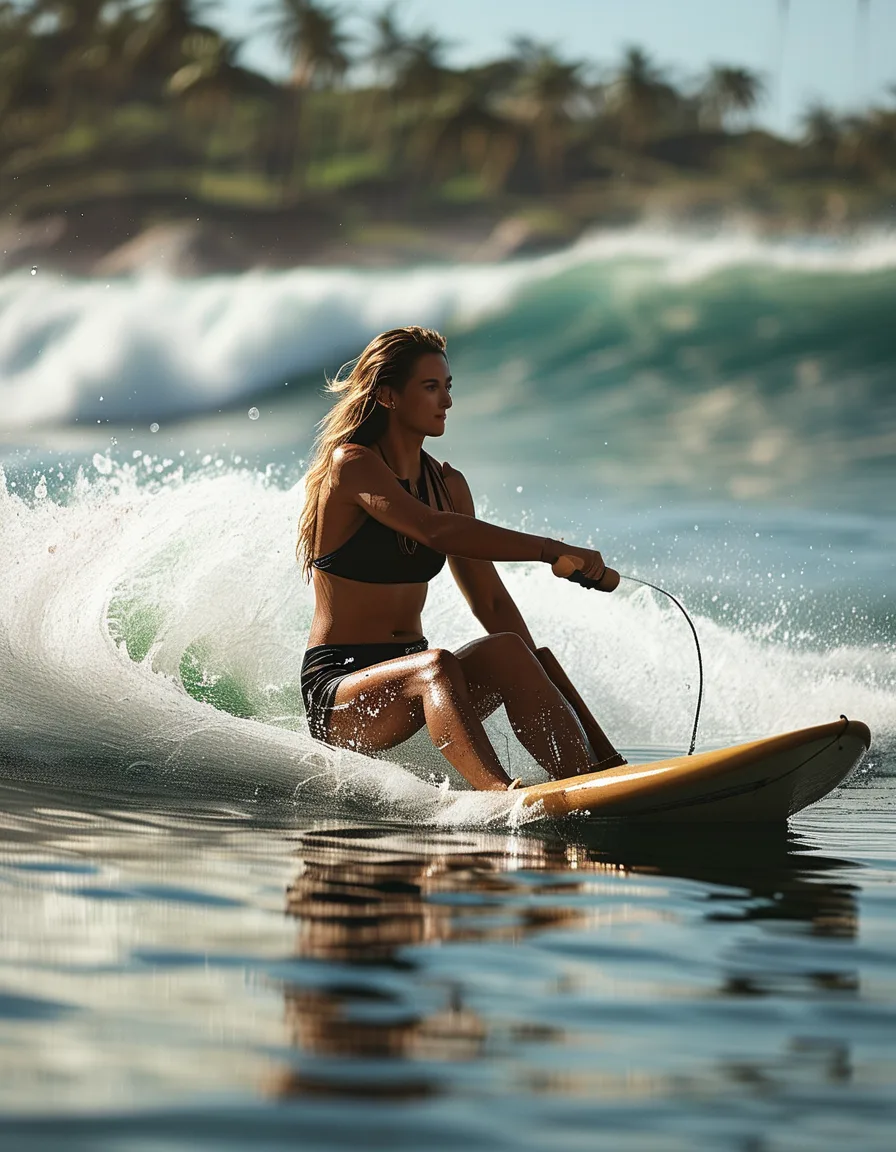
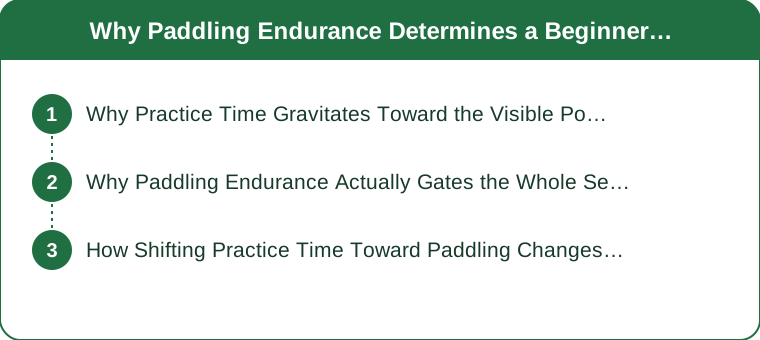
Why Do Beginners Over-Focus on the Pop-Up?
Because it’s the only part of surfing that can be taught on dry land and observed in real time.
An instructor can watch your pop-up, correct your hand placement, fix where your back foot lands, and have you repeat it fifty times on the beach. It’s discrete, visible, and coachable. Paddling is none of those things — it happens 40 yards out, it looks like everyone else’s paddling, and there’s no obvious feedback loop.
So practice time flows toward what can be observed. That’s a completely reasonable teaching decision and it produces a genuine distortion: beginners end up highly trained at the thing they do for two seconds and untrained at the thing they do for two hours.
Time breakdowns from surf sessions consistently show the same shape: paddling accounts for roughly 50–60% of total session time, waiting another 25–35%, and wave riding somewhere around 5–8%. The pop-up itself is a fraction of that last slice.
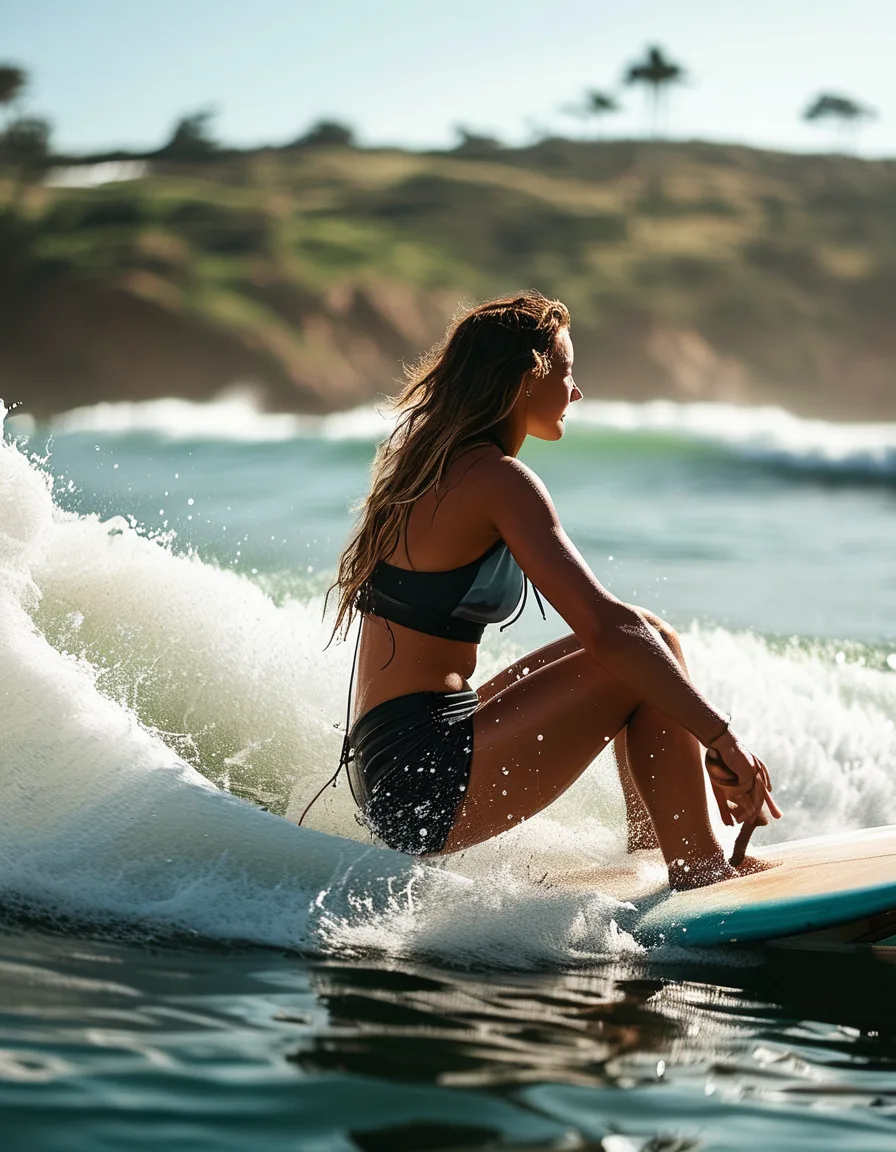
Why Does Paddling Endurance Limit Your Session?
Because it gates every wave attempt, and it degrades over the session in a way the pop-up doesn’t.
To attempt a wave you have to: paddle out through whitewater, hold position against the current, sprint-paddle to match the wave’s speed, and then pop up. The first three all draw on the same shoulder and upper-back endurance, and the third — the sprint to catch — is where beginners fail most often. Not because they can’t stand up, but because they can’t generate enough speed to get the board onto the wave face.
Then there’s the cumulative effect. Hour one you might attempt fifteen waves. Hour two, with fatigued shoulders and slower paddling, maybe six. Your pop-up technique is identical in both hours. Your wave count isn’t.
Blunt version: a perfect pop-up is worth exactly nothing on a wave you were too tired to reach.
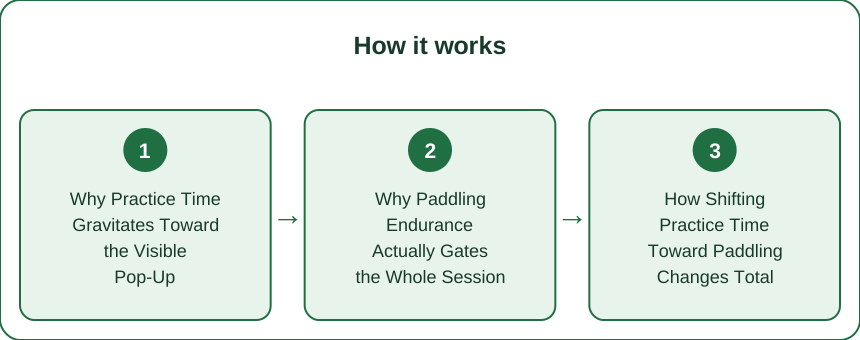
How Do You Build Paddling Endurance?
Train the shoulder and upper-back endurance that surfing actually demands, and do it on land or in a pool where you get consistent feedback.
Swimming — the closest transfer available. Freestyle 20–30 minutes, 2–3 times a week. It builds the same aerobic base and shoulder endurance, with the added benefit of improving your comfort and breath control in water. If you only do one thing on this list, do this one.
Prone paddle-position holds. Lie face down on the floor, lift your chest, and hold 3 sets of 30–45 seconds. Paddling requires sustained back extension, and it’s usually the lower back — not the arms — that fails first for beginners.
Resistance band pulls in the paddle motion. Anchor a band low, lie or lean prone, and pull through the paddle stroke path. 3 sets of 20 per arm. Trains the specific pattern under load.
Pull-ups, rows, and lat pulldowns. Paddling is a pulling motion driven by the lats. 2 sessions a week of pulling work builds the strength that endurance sits on top of.
Core anti-extension work. Planks and dead bugs. A stable core keeps you positioned on the board instead of sliding around and paddling inefficiently.
In the water, work on paddle technique too — high elbow, full extension, fingers slightly apart, and a deliberate stroke rather than a frantic one. Efficiency buys you endurance for free.
A realistic split: two swim sessions and one pulling session a week, alongside whatever water time you get. Most beginners see wave count rise within a month.
What Nobody Tells You About Board Choice
Some of the “I can’t catch waves” problem isn’t fitness at all — it’s the board.
A larger, higher-volume board paddles faster and catches waves with far less effort. Beginners on short boards are frequently fighting a paddling deficit that has nothing to do with their shoulders. A soft-top in the 8–9 foot range for an adult beginner isn’t a compromise; it’s the correct equipment, and it dramatically raises your wave count while you build the endurance.
Advanced surfers ride small boards because they can generate speed. That’s an outcome of skill, not a route to it.
FAQ
How long does it take to build paddling endurance for surfing?
With 2–3 swim sessions a week plus pulling work, most beginners notice a meaningful difference in 4–6 weeks — usually reported as “I lasted the whole session” before it’s reported as “I caught more waves.” Surfing regularly builds it too, just more slowly, since a beginner’s session includes a lot of rest.
Should I practice the pop-up at all?
Yes, but the returns come quickly and then flatten. Ten minutes of pop-up practice a few times a week is plenty to build the pattern; beyond that, additional time is better spent on paddling endurance where the returns keep coming.
Why can’t I catch waves even though I can stand up fine?
Almost always paddle speed — you need to be moving close to the wave’s speed for it to pick you up, and beginners typically start their sprint too late and paddle too slowly. Board volume is the other common cause; a bigger board fixes a lot of this immediately.
General recreation guidance. Surf within your ability, know the local conditions and hazards, and take a lesson before paddling out somewhere unfamiliar.
TL;DR:
- Paddling is 50–60% of session time; wave riding is around 5–8% — the pop-up is a sliver of a sliver
- The pop-up dominates practice because it’s the one visible, coachable moment on dry land
- Paddling endurance gates every wave attempt and degrades across the session, halving wave count by hour two
- Train it with swimming 2–3×/week, prone holds, band paddle pulls, and pulling strength work
- Board volume matters as much as fitness: an 8–9 ft soft-top is correct equipment, not a compromise
Keep Reading
This article is for general informational and styling purposes only. Fit, sizing, and product availability may vary.