Why You Still Can't Catch Waves Consistently After a Full Season of Trying
Quick Answer: Consistent wave catching depends far more on paddle timing, positioning relative to the breaking point, and reading approaching swell than on pop-up technique alone — many surfers spend disproportionate practice time on the pop-up (which is relatively simple once learned) while under-practicing the harder, less visible skills of positioning and wave-reading that actually determine whether you catch the wave in the first place.
You can pop up cleanly when a wave does carry you. The problem is how often a wave doesn’t carry you at all, and that gap points toward a different set of skills than the ones most surf lessons emphasize early on.

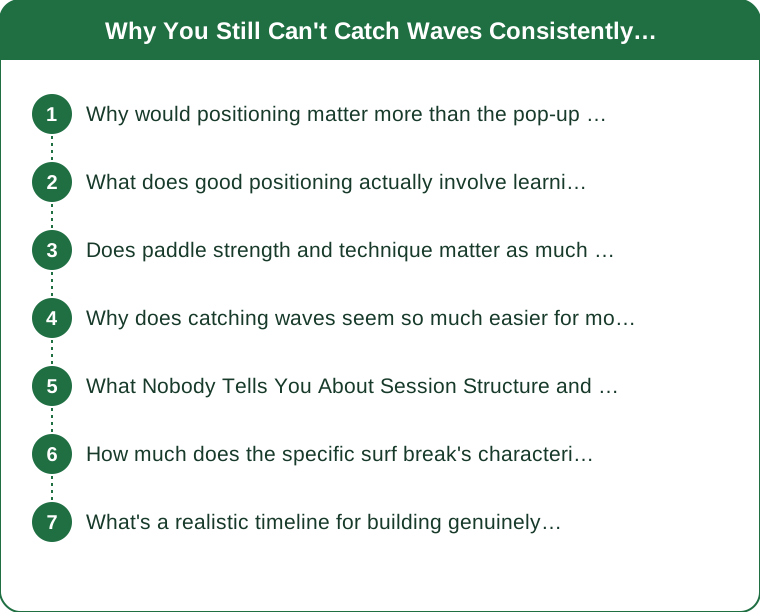
Why would positioning matter more than the pop-up itself?
The pop-up is a single, learnable movement that most people master with a reasonable amount of practice, often within the first several sessions. Positioning — being in the exact right spot relative to where a wave will break, at the exact right moment — is a continuously variable skill that depends on reading swell direction, timing, and the specific break’s characteristics, and it takes dramatically longer to develop because every wave and every session presents a slightly different version of the same underlying judgment call. Most surfers are still refining positioning judgment long after their pop-up has become automatic, which is exactly why wave-catching inconsistency often persists well after ‘the hard part’ feels solved.
What does good positioning actually involve learning to read?
Watching sets from the outside before paddling out, noting where waves consistently begin breaking relative to any fixed landmarks (a pier, a rock, a channel), and recognizing that the best takeoff spot is rarely exactly where you first see the wave rising — it’s usually a few feet ahead of where the initial visible bump appears, timed so your paddle speed matches the wave’s arrival at that spot. This is learned primarily through repeated observation and adjustment at a specific break over many sessions, not through a single lesson’s worth of instruction.
Does paddle strength and technique matter as much as positioning?
It matters, but as a compounding factor rather than the primary limiter for most intermediate surfers. Weak or inefficient paddling means you need to start paddling earlier and with better positioning to compensate for lower peak speed, but even excellent paddle technique with poor positioning still results in missed waves — positioning determines whether you’re even in a position where paddling hard enough matters, while paddle strength determines your margin once positioning is reasonably correct.

Why does catching waves seem so much easier for more experienced surfers in the same lineup?
Experienced surfers have internalized positioning judgment for that specific break (or breaks with similar characteristics) through hundreds of repeated observations of how sets there behave, allowing them to be already moving into position well before a beginner has even identified which wave in an approaching set is the one worth going for. This isn’t an innate talent gap — it’s accumulated pattern recognition specific to reading that kind of wave, developed through volume of exposure over time.
What Nobody Tells You About Session Structure and Skill Development
Here’s something surf instructors rarely emphasize enough in early lessons: spending an entire session focused purely on watching and paddling for position, without worrying about the pop-up or riding the wave at all, is a legitimate and often underused training approach. Deliberately practicing positioning in isolation — paddling for a spot, catching or missing it, resetting, and repeating — builds that specific judgment much faster than sessions where positioning, paddling, and pop-up are all being attempted together under the pressure of also trying to stand up successfully.
How much does the specific surf break’s characteristics affect how transferable this skill is?
Quite a bit — positioning judgment developed at one specific break (a beach break with shifting sandbars, for example) doesn’t transfer perfectly to a different type of break (a point break with a more consistent, defined takeoff zone), since the underlying swell behavior and the resulting best takeoff spots differ meaningfully between break types. Surfers who move between very different break types often report a noticeable, temporary dip in wave-catching consistency purely from having to relearn positioning patterns for the new environment, even with strong overall paddling and pop-up skills already established.
What’s a realistic timeline for building genuinely consistent positioning judgment?
For most people surfing regularly (multiple sessions per week) at a consistent home break, meaningful improvement in positioning judgment typically develops over 6-12 months, considerably longer than the weeks it usually takes to feel comfortable with the pop-up movement itself. This extended timeline is normal and expected — it reflects the genuinely higher complexity and variability of the skill being developed, not a sign of slower-than-average progress. Surfers who surf inconsistently or across many different, unfamiliar breaks often find this timeline extends further, simply because each new environment resets some portion of the pattern recognition they’d need to rebuild.
TL;DR:
- Positioning and wave-reading judgment, not the pop-up, is usually the real bottleneck behind inconsistent wave catching
- Watching sets before paddling out and noting consistent takeoff spots builds this judgment over repeated sessions
- Experienced surfers catch waves more easily due to accumulated pattern recognition for a specific break, not raw talent
- Dedicating whole sessions purely to positioning practice, without worrying about standing up, builds this skill faster
- A realistic timeline for solid positioning judgment is 6-12 months of consistent surfing, considerably longer than learning the pop-up
Next session, try spending the first 20-30 minutes purely watching sets and paddling for position without attempting to stand up at all — that isolated practice targets the actual skill gap behind most wave-catching inconsistency.
Keep Reading
This article is for general informational and styling purposes only. Fit, sizing, and product availability may vary.