Why Your Surfboard's Volume, Not Your Skill Level, Is Often What's Actually Slowing Your Progress
Quick Answer: Surfboard volume — the total foam displacement that determines how much floatation and paddling ease a board offers — has a bigger effect on early-to-intermediate progression speed than most surfers realize, and being under-boarded (riding a board with too little volume for current skill and wave conditions) commonly gets misread as a personal skill problem rather than an equipment mismatch.
Months of consistent effort, solid instruction, and genuine improvement in balance and paddling — and wave count still barely budges. For a lot of surfers, the missing piece isn’t more practice. It’s volume.

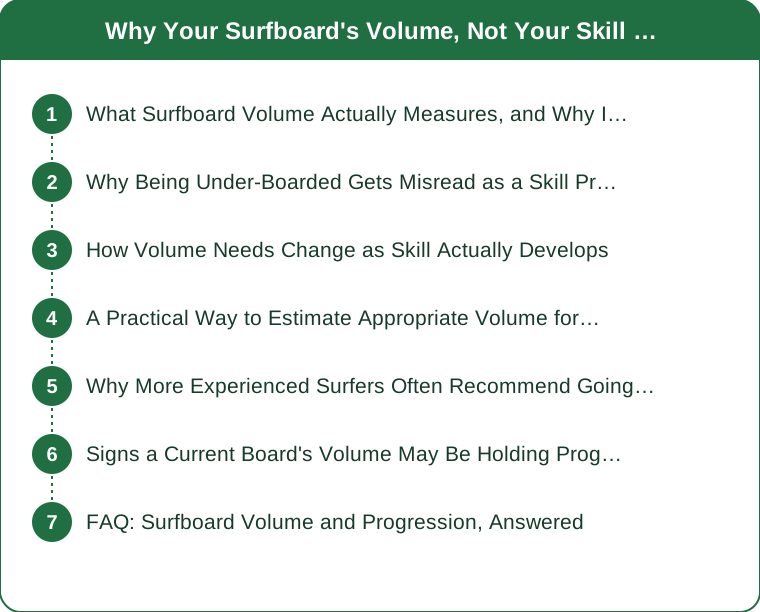
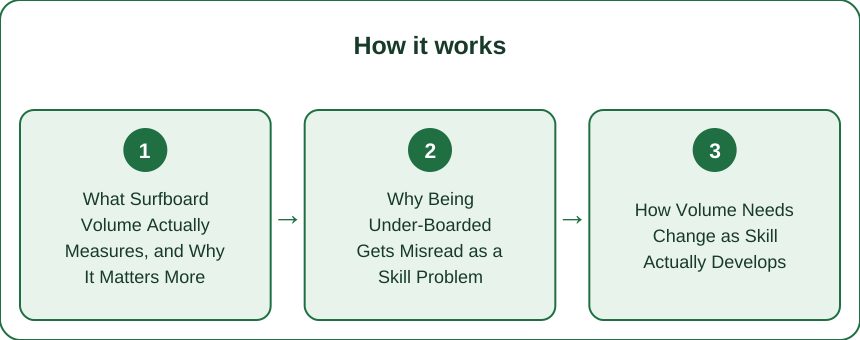
What Surfboard Volume Actually Measures, and Why It Matters More Than Length Alone
Volume is measured in liters and represents the total foam displacement of a board — how much water it pushes aside, which directly determines how much floatation and stability it offers a given rider’s weight. Two boards can be the same length but have meaningfully different volume depending on thickness and width, which is why judging a board purely by length, the most commonly discussed spec, misses a huge part of the actual performance picture. A higher-volume board catches waves earlier, paddles into position with less effort, and offers more forgiving stability while standing, all of which directly affects how many actual waves a surfer gets to practice on per session.
Why Being Under-Boarded Gets Misread as a Skill Problem
A surfer on a board with too little volume for their weight and current skill level has to work significantly harder to catch each wave, generate less stable pop-ups, and gets fewer total rides per session simply due to physics, not technique. This creates a frustrating feedback loop: fewer successful rides means fewer repetitions of the actual skill being practiced, which slows real progression, and the surfer often concludes incorrectly that they personally aren’t improving fast enough, when the underlying issue is that the board is actively working against easy wave-catching at their current stage.
How Volume Needs Change as Skill Actually Develops
Beginners generally benefit from meaningfully higher volume than their eventual advanced-stage board, since early-stage priorities are catching waves easily and building paddling and balance confidence, not performance maneuvering. As paddling strength, wave judgment, and pop-up consistency improve, gradually reducing volume allows for more maneuverability and a more responsive board feel, but reducing volume too early — often driven by wanting to look more advanced or match what more experienced surfers ride — reintroduces the exact under-boarded struggle a higher-volume board was solving in the first place.

A Practical Way to Estimate Appropriate Volume for Current Stage
A commonly used rough guideline multiplies body weight in pounds by a stage-based factor: complete beginners often do well around 1.3 to 1.7 times their body weight in liters of volume, intermediate surfers who can consistently catch and ride waves might drop toward 0.8 to 1.2 times body weight, and advanced surfers performance-riding smaller, more responsive boards may go well below that. These are starting-point estimates, not rigid rules, and actual wave conditions, paddling fitness, and board shape all interact with the raw volume number.
Why More Experienced Surfers Often Recommend Going Higher-Volume Than Feels ‘Cool’
There’s a common social pressure to ride a smaller, more advanced-looking board before actually being ready for the reduced volume, often because smaller boards are visually associated with skill level in surf culture. Experienced surfers and instructors frequently push back on this instinct specifically because they’ve seen how much faster genuine progression happens on an appropriately higher-volume board — more waves caught per session directly means more repetitions of the actual skills that need building, which outweighs any cosmetic downside of riding a slightly bigger board than desired.
Signs a Current Board’s Volume May Be Holding Progression Back
Struggling to catch waves that other surfers of similar skill level nearby are catching easily, feeling like pop-ups are unstable specifically due to board wobble rather than a technique issue, or needing significantly more paddling effort than seems proportional to conditions are all reasonable signs volume may be mismatched rather than a pure skill gap. Trying a rented or borrowed higher-volume board for a session and noticing a dramatic difference in wave count is one of the more direct ways to confirm whether volume, not skill, has been the limiting factor.
FAQ: Surfboard Volume and Progression, Answered
Is it worth buying a board specifically sized for right now, knowing it’ll need replacing as skill improves?
Yes — many experienced surfers and instructors recommend exactly this, treating the higher-volume board as a deliberate, temporary training tool rather than trying to buy one board meant to last through multiple skill stages.
Does board volume matter as much in small, gentle waves as in bigger surf?
Volume’s paddling and catch-ease benefit applies in both, though the practical impact is often most noticeable in smaller, weaker wave conditions where extra floatation makes the difference between catching a wave at all or missing it.
Can renting different-volume boards help figure out the right fit before buying?
Yes — this is one of the more reliable ways to feel the practical difference firsthand rather than relying purely on calculated volume estimates, and many surf shops specifically offer this kind of trial rental for exactly this reason.
TL;DR:
- Board volume, not just length, determines floatation, paddling ease, and wave-catching ability
- Being under-boarded creates a real physics disadvantage often misread as a personal skill problem
- Volume needs are highest for beginners and should decrease gradually as skill genuinely develops
- Rough weight-based volume estimates give a reasonable, adjustable starting point
- Struggling to catch waves others catch easily is a sign to check volume before assuming it’s technique
More volume than feels impressive is often exactly what makes faster real progress possible.
Keep Reading
This article is for general informational and styling purposes only. Fit, sizing, and product availability may vary.